The Long Road from a Yard to a Metre
The history of the yard and metre explains how dated standards made length comparisons clearer and how to convert between units without confusing precision.
The most common mistake in the history of the yard and metre is to treat familiar unit names as if they always meant one fixed length. That assumption could make a land boundary or cloth order hard to compare when local standards differed. The shift toward shared definitions took centuries, with identifiable milestones along the way.
Local measures made sense before national standards
Before modern standardization, rulers and authorities used customary measures that could vary by place and period. A hand, foot, or yard was familiar, but agreement on its name did not always mean agreement on its exact length. Local rules helped people conduct business nearby; they were less useful when plans or goods crossed boundaries.
In England, royal attempts to regulate measures date back to medieval times. The 1215 Magna Carta, for example, called for common measures of wine, ale, and grain, and referred to a standard yard. Such declarations show an early aim of consistency, but they did not instantly make every working measure identical across the country.
Britain fixed the yard in law before the metre was adopted widely
In 1824, Britain’s Weights and Measures Act established an imperial system that included a legally defined yard. A fire at the Houses of Parliament in 1834 destroyed the principal imperial standards, prompting the creation of replacement standards. In 1855, Parliament adopted new imperial standards, including a yard standard.
These milestones made the yard more consistent under British law, though other places and historical periods could use different definitions. A legal standard gave officials and makers a shared reference; it did not make every ruler or measuring technique equally reliable.
The metre began as a decimal project tied to the Earth
During the French Revolution, France pursued a new measurement system based on decimal relationships. In 1791, the French Academy of Sciences proposed defining the metre as one ten-millionth of the distance from the equator to the North Pole along a meridian. Surveyors then measured an arc of the meridian between Dunkirk and Barcelona to support the calculation.
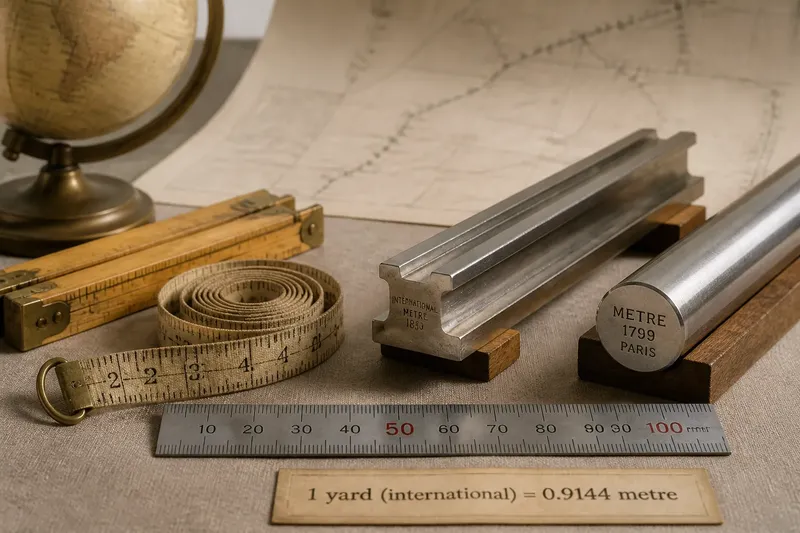
The work took years, and the resulting length was embodied in physical standards. France adopted the metric system in 1795, and a platinum metre bar was deposited in the French national archives in 1799. The Earth-based definition expressed the ambition behind the metre; the bar gave people a practical reference they could compare with working instruments.
International standards made the metre easier to share
As countries and industries needed measurements to agree across borders, a single national bar was not enough. In 1875, the Metre Convention established international cooperation on measurement standards. In 1889, an international prototype metre made of platinum-iridium became the reference for the unit.
A physical prototype made comparison more concrete, but any artifact can be damaged or become difficult to compare with distant copies. In 1960, the metre was redefined using the wavelength of light from a specified atomic transition. In 1983, it was defined using the speed of light and the second, a definition that remains in use. Laboratories can realize the metre from this definition and use it to calibrate instruments.
The yard and metre now connect through an exact relationship
In 1959, the United States, the United Kingdom, and other countries agreed on an international yard equal to exactly 0.9144 metre. That relationship lets people convert between the units without relying on a local guess about the yard’s length. For example, three yards equal 2.7432 metres before any rounding for a particular task.
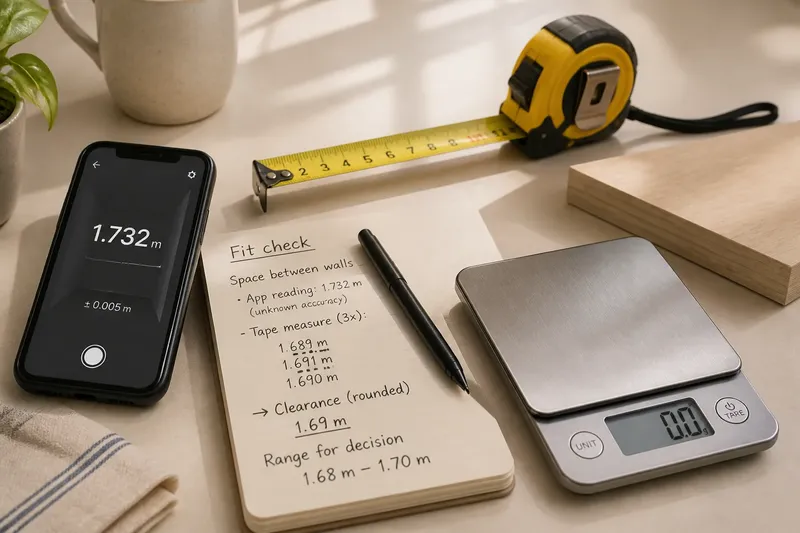
The number of digits you should write depends on the purpose and the source measurement. If a plan gives a length as three yards, reporting a converted value with many decimal places can suggest a level of detail the plan never supplied. Keep the exact conversion relationship distinct from the practical precision of the original measurement.
What do the historical milestones mean for a measurement today?
Why did the metre start with an Earth-based definition?
Revolutionary France wanted a decimal system whose units did not depend on a local ruler or body measure. Tying the metre to the Earth offered a common natural reference, although survey work and physical standards were needed to put the idea into practice.
Why did the metre’s definition change?
A physical bar and later wavelength-based definitions provided workable references, but standards bodies sought a definition that could be reproduced more consistently. The current definition uses the speed of light and the second, while laboratories connect that definition to practical instruments.
Is the yard-to-metre conversion exact?
Yes. The international yard is defined as exactly 0.9144 metre. A converted answer may still be rounded to match the detail of the source measurement or the needs of the job.
Does a common unit make every reading equally reliable?
No. A shared definition gives numbers the same unit, but a worn tape, poor alignment, or an imprecise source can still affect a reading. Record the unit and use only as much precision as the measurement supports.
Check the unit and source before using a converted length
- Observe whether the source states yards or metres. If it names one clearly, convert from that unit; if the unit is missing, ask the sender or consult the governing specification before acting.
- Observe how the original length is written. If it is rounded or given in broad terms, round the converted result to a similarly useful level; if it includes supported detail, preserve that detail in the conversion.
- Observe whether the conversion uses the international yard relationship. If it does, use 0.9144 metre per yard; if the document names a historical or specialized yard, verify that definition before converting.
- Observe whether the measuring tool is damaged or hard to read. If it is, repeat the measurement with a sound tape or ruler; if it is in good condition, record the reading and its unit.
- Observe whether a plan, contract, or label requires a particular unit. If it does, use that unit in the final record; if it does not, choose one and label every value consistently.
- Observe whether two measurements disagree. If they do, check the units, conversion, and measuring method before choosing a value; if they agree within the detail each supports, proceed with the stated precision.
Say you receive an invented furniture plan specifying a shelf length of three yards, and your work notes use metres. You multiply three by the exact conversion factor, 0.9144, and get 2.7432 metres; because the plan supplied a whole-number yard value rather than a finer measurement, you record the working length as about 2.74 metres and keep “three yards” beside it as the source. The result is a clear conversion, not a claim that the physical shelf was measured to four decimal places.
The history of the yard and metre is useful whenever a length moves between a document, a tool, and a person doing the work. Write the unit beside the number, note the source when it matters, and separate conversion precision from measurement precision. That small habit makes the result easier to check later, even when the next reader uses a different ruler.