The Decimal-Place Illusion: Why More Digits Don’t Mean More Accuracy
The decimal-place illusion makes a reading look exact. Learn to separate displayed precision from measurement certainty and choose useful digits.
The most common mistake with a precise-looking number is to treat every displayed digit as trustworthy. The decimal-place illusion can turn a rough estimate into something that looks settled, leading you to compare values or make decisions with more confidence than the measurement supports.
A phone app might report a room temperature to one decimal place, while a kitchen scale shows grams and a spreadsheet carries a long chain of digits. Those displays tell you how the value is written, not how closely it matches the quantity you wanted to know. To use a number well, separate its displayed precision from its measurement certainty, then choose a way to report it that fits the decision.
Displayed precision and measurement certainty answer different questions
Precision in a display is about detail: how many digits appear, or how small a change the instrument can show. Certainty is about how well the measured value represents the actual quantity, given the instrument, the method, the conditions, and the definition of what is being measured.
Think of a kitchen scale as a ruler with fine markings. Fine markings help you read small differences, but they do not automatically make the scale correctly calibrated, put the object in the right place, or remove the effect of a draft. A number can therefore have many decimal places and still have limited certainty.
There is another useful distinction: repeatability. If you measure the same thing several times under similar conditions and get closely grouped readings, the method is repeatable. That alone does not establish that the readings are close to the true value. A miscalibrated instrument can give consistent results that are consistently off.
The word “accuracy” is often used casually to mean “looks exact.” For a practical decision, ask instead what evidence supports the reported detail: the instrument’s stated resolution, its calibration information, the measurement procedure, and whether conditions could affect the result. A display cannot answer those questions on its own.
Choose among three ways to report a measurement
There is no single reporting style for every task. Pick the approach that matches what you know and what the reader needs to decide.
Use the instrument’s displayed digits when the reading is operational
Keeping the displayed digits is useful when you are reading a device for an immediate task, such as checking whether a timer has counted down or recording a scale reading for later comparison. It preserves what the instrument showed and avoids silently altering the observation.
This approach suits logging and troubleshooting, especially when the instrument model and procedure are recorded too. But label the figure as a device reading rather than implying that every digit is a dependable statement about the underlying quantity. If the device has a stated resolution or uncertainty, include that information when it matters to the decision.
Round to the precision the method supports
Rounding is often the clearest option for everyday communication. It avoids giving readers digits that the measurement process cannot justify, while keeping enough detail for the intended comparison.
This suits estimates, informal comparisons, and reports where a small difference would not change the action. Choose the rounding place before comparing values, and use the same rule for both. Rounding too early in a calculation can distort a result, so keep reasonable working digits during intermediate steps and round the final reported value.
Report a range when uncertainty could change the choice
A range communicates that the value is not known at one exact point. It can reflect variation across repeated readings, a stated instrument uncertainty, or a practical estimate of the limits of a method. Say what the range represents rather than presenting it as a formal uncertainty analysis if it is only an informal bound.
This suits decisions where the possible spread matters, such as checking whether an item is likely to fit a space. A range is less tidy than a single figure, but it can prevent a reader from treating a borderline result as settled. Avoid inventing a narrow range just to make the answer look rigorous.
Match the reporting choice to the decision
Start by asking what action the number is meant to support. If the decision depends only on a broad category, extra decimals add clutter. If a close comparison matters, preserve the original reading and explain the method or uncertainty instead of relying on the display alone.
- For a quick everyday estimate: round to a sensible place and state that the figure is approximate.
- For comparing two readings: use the same instrument and procedure where practical, and report both values at a consistent level of detail.
- For a borderline decision: report a range or take another reading with a suitable method, rather than letting a final digit decide by itself.
- For a record someone else may reuse: preserve the raw reading, identify the instrument and method, and separate those details from the rounded value used for the decision.
- For a regulated or safety-related threshold: follow the relevant standard and consult a qualified professional where needed; apparent decimal detail is not a substitute for an accepted measurement procedure.
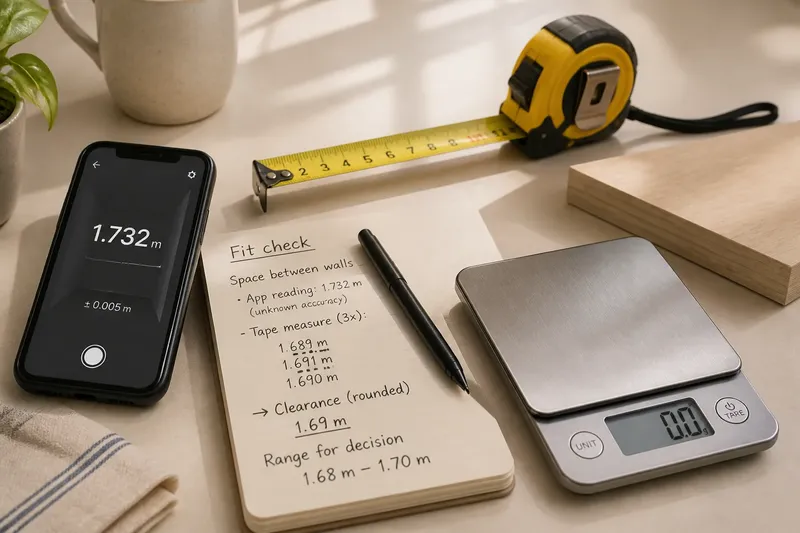
Say you are checking whether a shelf will fit between two walls, and a phone measuring app displays a length with several decimal places. The starting point is an app reading whose real-world certainty you do not know; you compare the space and shelf using a suitable tape measure, then report a rounded clearance or a range if the fit is close. The useful result is not a more elaborate decimal: it is a decision that allows for the uncertainty that could affect the fit.
Keep calculation digits separate from meaningful digits
Calculators and spreadsheets often retain more digits than the inputs justify. Those extra digits can help prevent rounding errors during a sequence of operations, but they do not create new information about the original measurement.
Suppose a calculation combines two measured lengths. Keep enough digits while doing the arithmetic, then consider the quality of both inputs and the purpose of the result before rounding. Reporting a long calculator output as though each digit were measured can make the final answer look more certain than either input.
When adding or subtracting, the least finely reported input can limit the useful decimal place of the result. When multiplying or dividing, the result’s useful detail is constrained by the quality of the inputs rather than by the calculator’s capacity. These are practical reporting conventions, not a way to calculate full uncertainty; use a formal method when the application requires one.
Also check whether the digits come from measurements or from exact definitions and counts. A counted set of objects and a measured length do not carry the same kind of uncertainty. Treating every number in a calculation as if it came from an instrument can lead to awkward rounding or misplaced confidence.
Check what a precise display can and cannot tell you
Does more decimal places mean a more accurate measurement?
No. More decimal places show that the value is written with finer detail, but the instrument or method may not support that detail. Look for information about resolution, calibration, and procedure before treating the extra digits as meaningful.
Should I round a measurement before calculating?
Usually, keep reasonable working digits through the calculation and round when you report the result. If you round each intermediate value, small changes can accumulate and affect the final answer. For formal work, follow the applicable measurement or reporting standard.
When should I give a range instead of one number?
Use a range when plausible variation could change the decision or when a single value would imply more certainty than the method supports. Explain whether the range reflects repeated readings, instrument information, or an informal estimate. A range should describe what is known, not disguise a guess as a precise bound.
Can repeated readings make a number certain?
Repeated readings can show whether a method gives similar results under similar conditions, but consistency is not proof of accuracy. The instrument could be miscalibrated, or the method could omit part of the quantity being measured. Repetition is useful evidence about variation, not a replacement for checking the measurement method.
Make the uncertainty visible to the next reader
A good measurement note lets someone tell what was observed, how it was obtained, and how much detail is appropriate for the decision. Keep the raw reading if it may matter later, but distinguish it from a rounded estimate or a range used to communicate the result.
The decimal-place illusion fades when you ask what each digit is doing. If it records a real distinction your instrument and method can support, keep it. If it only makes the number look authoritative, remove it or explain the limits—and choose the reporting approach that helps the next reader act sensibly.