Cups, Millilitres and the Question of Which Cup
Cups and millilitres can describe different kinds of measures. Learn how to read a recipe, choose a measuring tool, and avoid cup-size confusion.
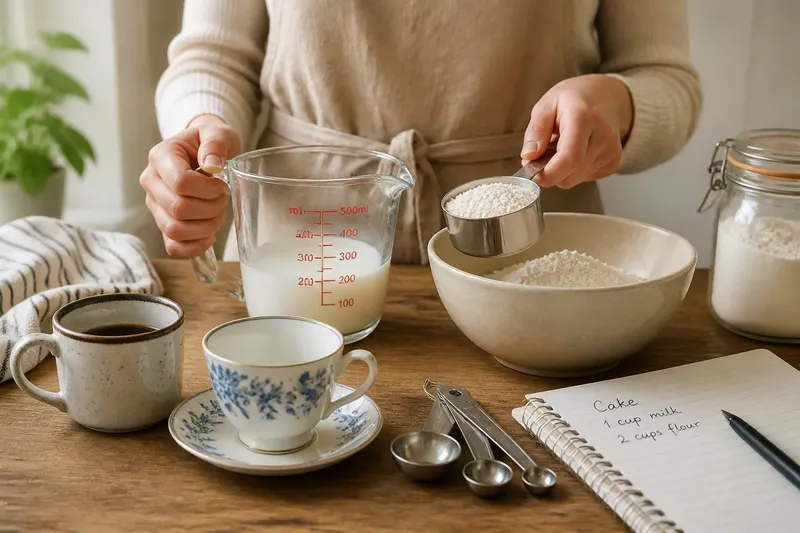
The most common mistake with cups and millilitres is treating every cup as the same volume. That can leave a recipe wetter or drier than intended, especially when a cup means a kitchen measure in one place and an ordinary drinking vessel in another. A stated volume in millilitres is more specific; a bare instruction to use “a cup” may need context.
Start by identifying what the recipe means by a cup
“Cup” can name a standard measuring unit, but it can also describe the container someone used to write down a recipe. Those meanings are not automatically interchangeable. A mug, teacup, and measuring cup may all be called a cup in conversation while holding noticeably different amounts.
Look at the source before measuring. A recipe that specifies millilitres, fluid ounces, or a particular cup convention gives you more to work with than a handwritten note that says only “one cup.” Check the recipe’s region, its accompanying unit system, and whether it consistently gives other ingredients in volume or weight.
Do not assume a vessel’s capacity from its name or appearance. If a family recipe says “one teacup of milk,” the intended measure may be that household’s teacup, not a standard unit. When the original container is available, it may help clarify the instruction, but it does not turn the recipe into a universally defined measure.
Use millilitres when the quantity needs a clear volume
A millilitre is a stated volume unit. It describes how much space a liquid occupies, rather than relying on the identity of a cup. That makes it easier to compare instructions across recipes or use a marked jug that shows millilitres.
For liquids such as water, milk, and stock, a graduated measuring jug is usually straightforward. Put it on a level surface, pour slowly, and read the scale at eye level. If the recipe gives a volume in millilitres, use that marking rather than filling an unrelated mug and hoping it is close.
For small amounts, a marked measuring spoon or a suitable graduated vessel can be easier to read than a large jug. Choose a tool whose markings are legible at the quantity you need. A container with only a few widely spaced marks may not make the intended amount clear.
Know what volume can and cannot tell you
Volume and weight answer different questions. Millilitres describe space occupied; grams describe mass. A millilitre of water is close in mass to a gram in ordinary kitchen use, but that convenient relationship does not apply equally to flour, oil, honey, or other ingredients.
This distinction matters most for ingredients that pack or settle. A cup of sifted flour can contain a different amount from a cup scooped firmly from a bag, even if both use the same volume measure. For a recipe that gives flour by weight, use a kitchen scale and follow the stated grams instead of converting by guesswork.
Think of a cup measure like a box: the box tells you the space available, not how heavy or tightly packed its contents are. The contents still affect the result. For dry ingredients, follow the recipe’s measuring method if it provides one, and avoid pressing ingredients into the cup unless the instructions say to do so.
Make a short routine for checking cup measures
Use this routine when starting a new recipe, then keep the chosen interpretation consistent through the ingredient list.
- Read the full ingredient list. Check whether the recipe uses millilitres, fluid ounces, grams, or only cup measures. A mix of units can reveal whether “cup” is meant as a formal measure or an informal container.
- Check the source and region. Look for a note explaining its cup convention. If the recipe does not say and the distinction could affect the dish, seek a clearer version rather than silently choosing a vessel.
- Choose a matching tool. Use a measuring jug for stated liquid volumes, a measuring cup for cup-based quantities, or a scale for weights. Avoid substituting a drinking mug for a marked measure.
- Read the markings carefully. Set a jug on a level counter and view the liquid line at eye level. For dry ingredients, use the method specified by the recipe and avoid compressing them accidentally.
- Keep one interpretation throughout. Do not use a household teacup for one ingredient and a standard measuring cup for another simply because both instructions say “cup.”
- Record any family convention. If a household recipe truly depends on a particular vessel, note which cup it means and keep that container with the recipe. That makes the instruction clearer for the next person.
Say you find a handwritten cake recipe that calls for “one cup milk” and “two cups flour,” with no unit note. You could check who wrote it and whether the intended cup is still known; if it is not, look for a clarified version before baking. The observable benefit is a usable instruction tied to a defined measure, rather than an arbitrary mug that may change both ingredients at once.
Which cup and volume questions come up most often?
Is a measuring cup the same as a coffee cup?
No. A measuring cup has volume markings or a specified capacity, while a coffee cup is a drinking vessel whose capacity can vary. Use the coffee cup only when a recipe explicitly means that particular household container.
Should I measure flour in millilitres or grams?
Follow the unit the recipe provides, and prefer grams when the recipe gives a weight. Flour can settle and pack differently in a volume measure, so a conversion is only as dependable as the method and ingredient assumptions behind it.
Can I convert a cup to millilitres?
Yes, if you know which cup convention the recipe uses. The word “cup” alone may not identify a single volume across all sources, so use a conversion that matches the recipe’s stated convention rather than assuming every cup is identical.
What should I do if a recipe only says “one cup”?
Check the source, surrounding units, and any notes for clues about the intended measure. If the ambiguity matters and those clues do not resolve it, use a more complete version of the recipe or ask its author rather than choosing an unmarked household vessel.
Choose the measure that the instruction actually names
When a recipe names millilitres, measure millilitres; when it names grams, weigh the ingredient. Treat “cup” as a unit only when the recipe’s convention is clear, and as a container only when the intended vessel is identified. For cups and millilitres, that small distinction is what turns a familiar word into a repeatable kitchen instruction.
Where a conversion depends on a recipe’s convention or a measuring tool’s markings, follow the recipe, tool label, or manufacturer instructions. If a recipe leaves the measure undefined, clarify it before relying on the result.